

Prepare subcontractor 1099s with a practical guide to W-9s, 2026 reporting thresholds, payment tracking, filing deadlines, and corrections.
Back to contractor finance →Who Gets a 1099-NEC and Who Doesn't
For 2026 payments, the general federal Form 1099-NEC reporting threshold is $2,000 per payee, subject to exceptions. The older $600 threshold applied to 2025 payments. First confirm which year's payments you are reviewing, then check the payee, payment type, and payment method. The first question is still: subcontractor or employee?
Collect the W-9 during onboarding, track payments throughout the year, and reconcile each vendor before preparing returns. For 2026 payments, the usual January 31 deadline falls on a Sunday, so the federal Form 1099-NEC filing and recipient deadline moves to Monday, February 1, 2027.
Form 1099-NEC reports nonemployee compensation paid to independent contractors. It replaced the old 1099-MISC box 7 for this purpose.
Worker classification follows the actual relationship, not the label on an agreement or the form you issue. Misclassification can create payroll-tax and other obligations. A W-9 or 1099 does not establish that someone is an independent contractor.
The IRS guide to worker classification lays out the common-law test. The IRS groups evidence into three broad areas:
- Behavioral control: Do you direct how the work is done, or only the result?
- Financial control: Does the worker set their own price, supply their own tools, and take a profit or loss?
- Relationship: Is there a written contract, benefits, or an indefinite arrangement?
The Subcontractor 1099 Decision Tree
Run every payee through these questions in order:
- Is this a nonemployee providing services to your business? Employee wages generally belong on Form W-2. Personal payments are outside this business reporting workflow.
- What does the W-9 say about federal tax status? Sole proprietors and partnerships are generally within the reporting rules. C and S corporations, including LLCs taxed that way, are generally exempt for ordinary subcontract services. Exceptions include legal services.
- Which payments are yours to report? Separate cash, checks, and direct bank transfers from payment-card and qualifying third-party network transactions.
- Do your reportable 2026 payments reach $2,000 for the year? Combine payments across all jobs for the same payee. Special rules can require a return below that amount, including when federal backup withholding occurred.
- Is the payee a foreign person? Stop and have your tax preparer review the documentation, reporting, and withholding rules rather than treating this as an ordinary W-9/1099-NEC situation.
Do not judge status by a crew's tools or schedule alone. Evaluate the whole relationship. For the threshold and reporting exceptions, use the IRS Form 1099-NEC instructions.
The W-9 Form for Subcontractors: Collect It Before the First Payment
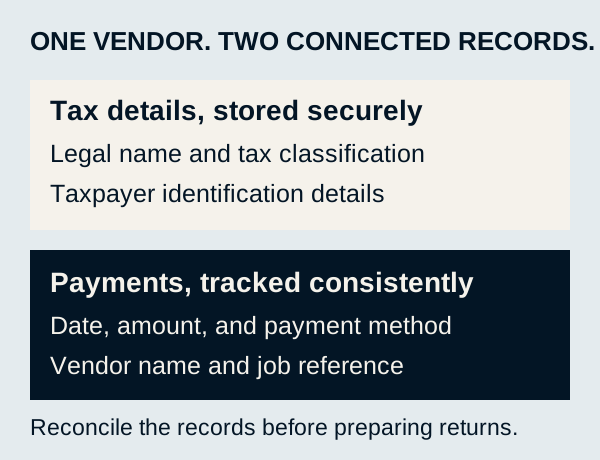
Get the W-9 form for subcontractors signed before you cut the first check. Not after the job, not in January.
The W-9 gives you the legal name, taxpayer identification number, and entity type you need to file a correct 1099. Without it, you are guessing, and guesses trigger IRS notices.
Build W-9 collection into subcontractor onboarding and explain the requirement before work begins. Coordinate payment procedures with your contracts and applicable payment obligations; do not assume paperwork lets you ignore an amount already due.
What to Check on the W-9 Before You File It
A signed W-9 is not the same as a correct W-9. Before the form goes into your vendor file, confirm:
- Line 1 name matches the IRS records. A sole proprietor may write a personal name on line 1 and a DBA on line 2. The 1099 must use the line 1 name.
- The TIN matches the entity type. A single-member LLC that has not elected corporate treatment generally provides the owner's SSN or EIN. An LLC taxed as a corporation provides its EIN and is generally exempt from 1099-NEC reporting.
- The entity box is checked. This tells you whether the corporate exemption applies.
Eligible payers can use the IRS Taxpayer Identification Number matching program before filing. A mismatch is a reason to investigate the name and number, not permission to guess. Follow the IRS instructions for requesting Form W-9, especially for disregarded entities and LLC tax classifications.
When the W-9 Comes Back Missing or Wrong
A missing or incorrect TIN can create filing problems and backup-withholding obligations. The current federal backup-withholding rate is 24% where required. Use the IRS backup withholding guidance and your tax preparer to determine when to start, how to deposit it, and when it can stop. A prefiling mismatch and an IRS notice do not necessarily call for the same procedure.
A practical response plan when the W-9 is incomplete or the TIN fails to match:
- Ask in writing. Send a fresh W-9 request by email and keep the message. A phone call is not a record.
- Set a follow-up date. Request a prompt response, but do not delay any withholding obligation while waiting.
- Resolve discrepancies. If eligible, run a TIN match. If the number does not match, ask the sub to confirm the legal name and TIN against their records.
- Withhold if required. Follow the applicable backup-withholding and IRS-notice procedures with your preparer. Deposit and report withheld tax correctly, including on the required information return.
- Document everything. Keep written requests, W-9s received, and match results with the vendor file.
Never invent a TIN or copy one from an old form without confirming it. A fabricated number is worse than a missing one because it looks compliant until the IRS matches it.
The IRS independent-contractor guidance says to keep the W-9 in your files for four years. Store it securely with access limited to people who need it. Use a secure collection method because the form contains sensitive taxpayer information.
W-9 Collection Checklist for Subcontractor Onboarding
- W-9 requested before the first payment, not after
- Line 1 legal name verified against the sub's own records
- Entity type box checked and corporate exemption evaluated
Which Payments Belong on the Form
Report payments for services, subject to the payee and payment-method rules. That includes labor, subcontract work, and professional services such as an outside estimator.
A materials receipt does not automatically turn part of a subcontract payment into a nonreportable reimbursement. Distinguish buying merchandise from paying for a service that includes parts or materials. Separating lines on the invoice is useful for job costing, but it does not by itself determine the tax reporting.
Labor, Materials, and Reimbursements: A Construction Decision Framework
Use this table to flag payments for review, rather than deciding only from the invoice's wording.
Swipe the table to read all columns.
| Invoice pattern | Reporting approach | What to check |
|---|---|---|
| Lump-sum subcontract for labor and materials | Generally include the service payment, including incidental materials | Payee status, payment method, and annual total |
| Labor and incidental materials shown separately | Do not automatically exclude the materials | Itemization alone does not change the underlying service payment |
| Merchandise or supplies purchased without services | Generally outside 1099-NEC service reporting | Confirm this was a goods purchase rather than part of a service arrangement |
| Equipment rental with an operator | Review the allocation between rental and operator service | The rental portion may belong on 1099-MISC; operator charges may belong on 1099-NEC |
| Equipment rental without an operator | May require 1099-MISC rent reporting | Being outside 1099-NEC does not mean no information return is needed |
| Permit or inspection fee passed through by a sub | Review the facts with your preparer | An at-cost label alone does not settle treatment |
| Change order performed by the same sub | Include reportable service payments in that payee's annual total | Combine jobs and changes without duplicating entries |
| Retainage held and paid in a later year | Generally review for the year actually paid | Do not substitute the invoice or contract date for the payment date |
Hypothetical Example: A Framing Sub Across Two Jobs
The following is a hypothetical illustration, not a client result.
A noncorporate framing sub works two jobs in 2026 and is paid by check. Job A includes $18,000 for framing labor and incidental materials. Job B includes $9,500 for labor and $4,200 for incidental materials supplied as part of the framing service, shown separately on the invoice.
Assuming these are all reportable service payments and there are no other adjustments, the annual Form 1099-NEC amount is $31,700: $18,000 plus $9,500 plus $4,200. Separate material lines and receipts do not automatically reduce it to labor only.
Your job-cost report can still separate labor and materials. Tax reporting and job-cost categories answer different questions. Reconcile the full vendor payment total, then document any reporting adjustments with your preparer.
Payments That Are Easy to Misclassify
A few construction-specific cases come up often enough to call out:
- Second-tier subs paid through a general contractor. For ordinary direct payments, evaluate your payments to the sub under the reporting rules. The sub generally handles its own crew payments. Joint checks, payment-agent arrangements, or unusual oversight structures need a separate review.
- Owner draws and profit distributions. Not reportable on a 1099-NEC. Those are not payments for services.
- Payments to a sub's employees. If the sub's crew is on the sub's payroll, you do not issue them 1099s. You pay the sub, and the sub handles its own payroll.
When a payment sits on the line, document your reasoning on the invoice or in the vendor file. A clear record lets the preparer review the decision without reconstructing it from a bank statement.
Tax treatment of specific payments can depend on your entity structure and the facts of the job. Confirm edge cases with your CPA before you file.
1099 Subcontractor Payment Tracking You Can Reconcile
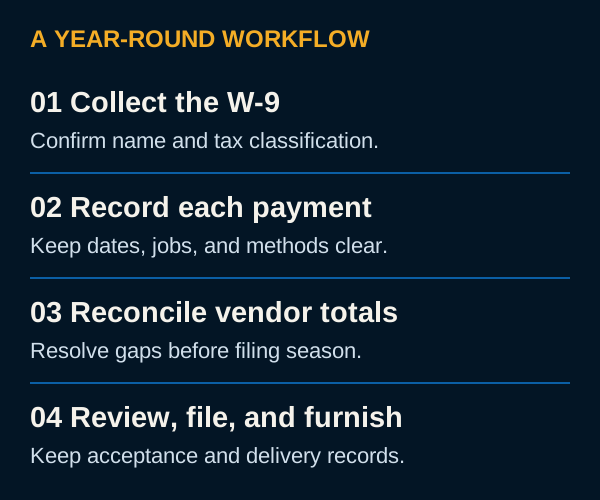
Good 1099 subcontractor payment tracking starts with a clean vendor list and a running total per payee, updated as you pay. Not reconstructed in January from a shoebox.
Set up each sub as a vendor in your accounting software before the first payment. Run a year-to-date report monthly and compare it to your job cost records. Construction bookkeeping keeps job costs and subcontractor records clean.
A practical year-round checklist:
- Signed W-9 on file for every sub
- Vendor set up with legal name, tax status, and securely stored TIN
- Every payment coded to the vendor, not a generic expense line
- Job number and payment method recorded alongside the payment date
- Duplicate vendor names, voided checks, refunds, and year-end adjustments reviewed
- Reportable annual totals reconciled to the books before filing
If your QuickBooks setup is the weak link, QuickBooks job costing for contractors shows a practical setup so subcontractor payments and job costs are recorded consistently.
Payment-Method Rules and Third-Party Settlement Reporting
How you pay changes who reports. Cash, check, and ACH from your own account are yours to report on a 1099-NEC.
Payment-card transactions and qualifying third-party network transactions fall under separate Form 1099-K rules and are generally excluded from your Form 1099-NEC reporting. That exclusion is not simply conditional on the sub actually receiving a 1099-K. Do not assume every payment app transfer qualifies: verify how the specific transaction was processed.
Record the method for each payment. If a vendor receives both card and check payments, separately total the payments that remain subject to your reporting. Ask your preparer how to treat an unclear app transfer before excluding it.
The 1099-NEC Filing Deadline and How to File
Form 1099-NEC is generally due to both the IRS and the recipient by January 31 after the payment year, with a next-business-day adjustment for weekends and applicable holidays. For 2026 payments, that date is February 1, 2027. Other 1099 forms can have different filing deadlines.
File by:
- Gathering every vendor's year-to-date total in early January.
- Confirming each W-9 is current.
- Preparing Forms 1099-NEC, one per payee.
- Filing electronically or by paper, and sending each sub their copy.
Electronic filing is generally required when you file 10 or more information returns in aggregate, counting the return types covered by the rule, not just subcontractor 1099s. Check the IRS e-file requirements for information returns before planning on paper. Where paper filing is permitted, follow the official form and transmittal requirements rather than printing an ordinary screen copy for the IRS.
If filing yourself, arrange access early. The IRS identifies IRIS as the electronic filing platform for the 2027 filing season for these returns; a provider may handle submission for you. Verify acceptance, not just submission, and retain the recipient-delivery record. Missing a deadline can trigger penalties, so build reconciliation and review into the January calendar.
State Filing Requirements
Federal filing may not finish the job. Many states require their own copy of the 1099-NEC or a separate state information return, and state deadlines do not always match the federal deadline.
Check your state's revenue department for:
- Whether a state 1099 filing is required
- The state deadline, which may differ from the federal one
- Whether the state accepts the federal form or wants its own
Rules vary enough that a multi-state contractor should confirm each state separately rather than assume one process covers all.
The 1099-NEC Correction Process When Something Is Wrong
The 1099-NEC correction process starts with the type of error and whether the IRS accepted the original return.
- Before filing: fix the draft and submit the accurate original. Do not mark an unfiled draft as a correction.
- Rejected submission: follow the filing system's rejection or replacement instructions. A rejected return is not necessarily an accepted original that needs correction.
- Accepted return with an incorrect amount: use the applicable correction process and provide the recipient with the corrected statement.
- Accepted return with an incorrect name or TIN: confirm the payee details, then follow the identity-error procedure for your filing method. Paper corrections can require two returns; checking a correction box on a replacement name or TIN is not a universal solution.
Use the correction guidance in the IRS general information-return instructions and your filing provider's current workflow. Do not send another unmarked original for an already accepted return.
Keep a log of what was wrong, what changed, when it was submitted, whether it was accepted, and when the recipient received the replacement. File the confirmation with the original records so the next person can follow the trail.
Get Subcontractor Records Ready Before Filing Season
Filing 1099s correctly starts with clean records all year. If W-9s, subcontractor payments, and job costs are scattered across spreadsheets and folders, start by bringing the records together and identifying what your tax preparer still needs.
Golden Bookkeeping helps contractors organize monthly books, job costs, and payment records so reporting and owner decisions start from reliable numbers. Our construction bookkeeping services provide the foundation; fractional CFO guidance connects reliable reporting to cash planning and profitability decisions.
A free Profit Review is a practical place to discuss the condition of the books and the next step. Coordinate final filing decisions, worker classification, and unusual payments with your CPA or tax preparer.
Frequently asked questions
Do I issue a 1099-NEC to a subcontractor who is an LLC?
An LLC is not automatically exempt or automatically reportable. Check the federal tax classification on its W-9. LLCs taxed as C or S corporations are generally exempt for ordinary subcontract services, while sole-proprietor and partnership treatment generally remains within the reporting rules. Disregarded entities use their owner’s reporting details as instructed on Form W-9. Exceptions and payment-method rules still apply.
What is the 1099-NEC threshold for 2026 subcontractor payments?
The general federal threshold is $2,000 in reportable payments to a payee for 2026, replacing the $600 threshold used for 2025. Combine payments across jobs for the same payee, then apply the payee and payment-method rules. Special cases, including federal backup withholding, can require reporting below the general threshold.
When are 2026 Form 1099-NEC copies due?
The usual January 31 deadline shifts to Monday, February 1, 2027, because January 31 is a Sunday. That is the general federal deadline for filing 2026 Form 1099-NEC with the IRS and furnishing the recipient statement. Check state obligations separately and leave time to resolve rejected submissions.
Can I exclude materials if the subcontractor lists them separately?
Not automatically. A service payment can include reportable incidental parts or materials even when the invoice itemizes them. A standalone purchase of merchandise is different. Keep the invoice, agreement, and payment record together and have your preparer review any reimbursement or allocation before excluding it.
How do I correct an incorrect name or taxpayer identification number?
Confirm the correct details from the payee, check whether the original was accepted, and follow the identity-error correction procedure for your filing method. Paper corrections can require a two-return process. Electronic filers should follow their provider or IRS system instructions, rather than assuming a new form with the correction box checked will always fix it.
Should I collect a W-9 before paying a subcontractor?
Collect it during onboarding, ideally before the first payment. It provides the legal name, tax classification, and taxpayer identification number needed for reporting. Keep it securely, follow up on missing details promptly, and review any backup-withholding obligation with your tax preparer. Coordinate payment procedures with the subcontract and applicable payment requirements.
Related insights

